
Part 2: Begged, Then Betrayed – The Architecture of Indentured Care
In 2022, the UK clapped for them. In 2025, it fenced them in. In this explosive second part of our Capital Violence series, Rev. Joseph Dennis Nii Noi Quarcoo (Joe Quarcoo) peels back the "Discursive Mask" of the Home Office to reveal a terrifying new reality: The Architecture of Indentured Care. This isn't just about immigration policy; it’s about Intellectual Extraction. Discover how the state is systematically "de-skilling" a workforce of doctors, lawyers, and engineers, trapping them in a cycle of permanent temporariness to subsidize a failing care system. From the "Necropolitics" of family separation to the "Psychological Siege" of moving goalposts, this article exposes the Beautiful Lie of migration control and the Gritty Truth of state-sanctioned indenture.
CRITICAL REFLECTIONS & DECOLONIAL INQUIRYCAPITAL VIOLENCE
Joe Quarcoo
3/3/202610 min read


The Critical Implication: A Fractured Society
The result of this Discursive Institutionalism is a Psychological Siege. It creates a society where the care worker—the person holding the hands of the most vulnerable—is viewed with suspicion by the very neighbors they serve.
The Migrant lives in fear of the next policy change, creating what Makai (2025) calls the “Leaking Soul.”
The Local is manipulated into anger, preventing the cross-cultural solidarity needed to demand better conditions. This hinders the social cohesion that the Home Secretary claims to seek. You cannot build a cohesive society on a foundation of punitive and unfair proposals that treat human beings as mere "units of labour."
Crucially, this hinders the social cohesion and integration that the Home Secretary claims to seek. You cannot build a cohesive society on a foundation of punitive and unfair proposals.
8. The Breach of the Psychological Contract: A Legacy of Betrayal
The most chilling implication of these retroactive reforms is the total demolition of the Psychological Contract. When thousands of professionals chose to leave their homes, pay exorbitant fees, and serve the UK, they did so based on a set of rules. To change those rules mid-stream is more than a policy shift; it is a structural breach of trust.
If the Home Office can arbitrarily double the settlement baseline in 2025, who is to say they won't change it again in 2035? What is to stop a future Home Secretary from extending the 10-year wait to 15, or adding new, impossible criteria just as a worker reaches the finish line? This creates a state of Permanent Contractual Precarity.
From a psychological perspective, this is a form of Institutional Abuse. It keeps the migrant in a state of hyper-vigilance, unable to truly invest in their community or their own future because the "sovereign" reserves the right to betray the agreement at any moment. As Mbembe (2019) might argue, this is the ultimate expression of sovereignty: the power to define the "truth" of a contract today and declare it "void" tomorrow.
The Breach of Trust: Is the UK Still a Credible Partner?
This leads to a chilling conclusion: Can we ever consider the British government a trustworthy and credible partner in the global labour market? When a state acts with this level of "discursive dishonesty"—begging for heroes during a pandemic and then branding them "unsustainable" when the bill comes due—it burns its Reputational Capital. By choosing the short-term "win" of lower net migration statistics over the long-term integrity of its immigration system, the UK is signaling to the world that its word is not its bond.
If the Home Office can arbitrarily double the settlement baseline in 2025, who is to say they won’t change it again in 2035? The UK is signaling to the world that its word is not its bond.
This creates a state of Permanent Contractual Precarity and Institutional Abuse. For the African and global South diaspora, the message is clear: You are here on a Conditional Invitation. You are expected to be "loyal" to a state that is systematically "disloyal" to you. This is not a partnership; it is an extractive relationship that wears the mask of "earned settlement."
The Advocacy Path: What Should We Do?
We must call this what it is: State-Sanctioned Indenture.
Expose the "Lock-In": Demand the Home Office admit they are using ILR as a tool to prevent labour mobility in a failing sector.
Demand a "Right to Progress": We must challenge the idea that ILR is a "privilege" for those who have fulfilled a legal work contract. In a fair society, labor is a contribution that earns a right to belonging.
Challenge the Contractual Breach: Organize legal and social challenges to the retroactive nature of these proposals. Laws that change the status of people already present violate the principle of Legal Certainty.
Build Our Own Credibility: Since the state has proven itself an unreliable narrator, the diaspora must become its own source of truth. We must document every fee paid, every hour worked, and every family separated to build the "monument of evidence" that will eventually tear down these fences.
Expose the Planning Failure: The "unsustainable" numbers are a governmental planning failure, not a migrant fault. Once there is fair pay in social care, native Brits will take up roles, and the "need" for migration will naturally shift.
Clarity in the Murk: Distinguish the narrative. These are legal, highly educated workers invited under a specific contract.
Professional Recognition: We must use our platforms to highlight that this "low-skilled" workforce is actually an Intellectual Surplus of graduates and highly skilled professionals who are being structurally suppressed in a country that claims to champion human rights.
Demand Professionalization: We must move the conversation from "migration" to "labour rights." A Fair Pay Agreement and a National Care Service would benefit both the local and the migrant, breaking the state's "divide and rule" tactic.
The "Beautiful Lie" is that the UK needs migration control. The "Gritty Truth" is that the UK needs a captive workforce to subsidize its refusal to pay a living wage.
Publish your next book or bring your advocacy to life with Guiding Light Press. We are the home for those who refuse to be "branded out of belonging." This is the Literature of Liberation!
Grab your copy of Capital Violence here
You may also like:
Part 1: Contesting Fenced Futures – Capital Violence and the African Diaspora in a Shrinking World
Unsettling Truths: Why This Book Is Shaking My Ministry to Its Core
The Paternalism Tax: Why Mission Aid Creates Dependency, Not Partnership
Displaced Faith: Rethinking Evangelism in a Post-Christendom World – Insights from Unsettling Truths
Unity Does Not Mean Homogeneity
Contact us:
•Website: guidinglightpress.co.uk
•Email: hello@guidinglightpress.co.uk
•Address: Guiding Light Press, 4th Floor, Silverstream House, 45 Fitzroy Street, Fitzrovia, London, W1T 6EB.
#TheHustle #Voice1Africa #GuidingLightPress #CapitalViolence #FencedFutures #DiscursiveInstitutionalism #StateIndenture #LaborRights #DeJoeQuarcoo #WavinyaMakai #UKImmigrationReform #JoeQuarcoo #UKILRreforms2026MigrantCareWorkersExploitation
Reflections on Wavinya Makai’s Capital Violence – A Guiding Light Press Review Series
"Was it the UK’s plan to promote dysfunctional families across the Global South; to dictate that an African mother can care for a British grandmother, but she cannot care for her own child on British soil?"
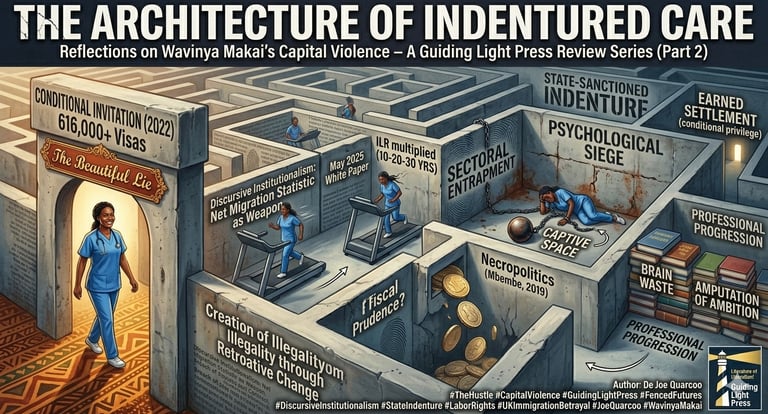
The May 2025 Immigration White Paper marked a violent shift in tone. Suddenly, the very workers who were celebrated as "essential" in 2022 were labeled “unsustainable” (Home Office, 2025). As a Critical Human Geographer and Applied Social Psychologist, I recognize this as a masterclass in Discursive Institutionalism. The state is using "net migration" as a weaponized statistic to justify not only the July 2025 ban on overseas care recruits but also the exclusionary, retroactive "Earned Settlement" proposals.
To understand this betrayal, we must expose the eight pillars of this new architecture of indenture.
1. The Responsibility Vacuum: Who Issued the Visas?
Whose responsibility was it to ensure that the numbers coming in were "manageable"? It was the Home Office that designed the Health and Care Visa as well as the Skilled Worker routes. It was the Home Office that issued over 616,000 visas (Home Office, 2024). This is not a matter of party politics; the UK government legally and officially invited this talent pool.
They received billions in visa application fees, processing fees, and—post-2024—the Immigration Health Surcharge. To treat these workers as a "burden" after taking their money and their labor is a profound moral and contractual betrayal. When the state invited "family heads," did they believe Black and Brown people were biological machines without hearts or homes? To now blame the legal migrant for bringing their children and spouses is the height of hypocrisy. It suggests a darker undercurrent: Was it the UK’s plan to promote dysfunctional families across the Global South? Extracting the "productive" member of a family while fencing off their loved ones is a form of Necropolitics (Mbembe, 2019). It is the power of the state to dictate that an African mother can care for a British grandmother, but she cannot care for her own child on British soil.
2. Pitching "Native" against "Migrant": The Scarcity Trap
Through a psychological lens, I am deeply concerned by how this discursive approach intentionally pitches the "local" against the "migrant." By labeling legal care workers as "competitors" for limited benefits and housing, the state creates a Scarcity Mindset.
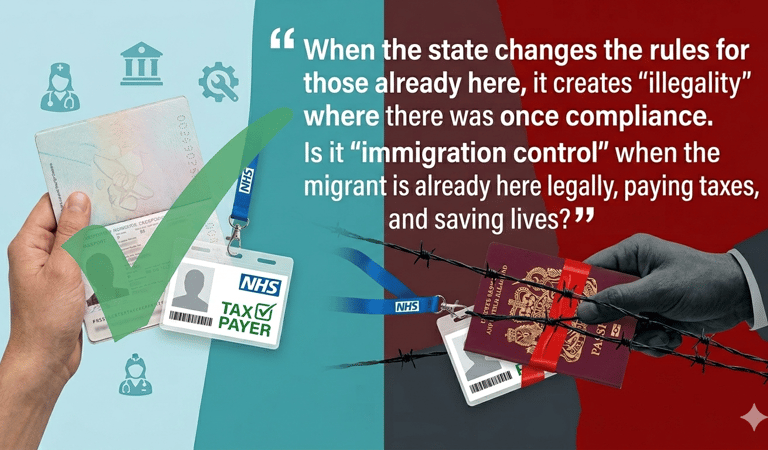
This is what Miraftab (2009) describes as the manipulation of “invited spaces” and what Teresa Caldeira identifies as the state's "creation of illegality." When the state changes the rules for those already here, it creates "illegality" where there was once compliance.
Through discursive language, the state uses public emotion to justify its own wicked practices. When the Home Office blurs the narrative between legal workers and illegal crossings—dumping them both into the murky bucket of "Net Migration"—they are intentionally inciting passion to justify their position. They are using the migrant as a shield. If the local person cannot get a hospital bed or a council house, the government points at the care worker instead of their own failure to fund a National Care Service or urban infrastructure. This is Spatial Injustice (Vawda, 2023) rebranded as "border control." But we must ask: Is it "immigration control" when the migrant is already here legally, paying taxes, and saving lives?
3. The "De-Skilling" Deception: Intellectual Extraction
Perhaps the most dishonest tactic is the broad-brush labeling of the care workforce as “low-skilled.” By focusing solely on the job code (below RQF6), the state intentionally ignores the caliber of the human beings performing the work.
Data reveals a staggering reality of "Brain Waste":
The Qualification Gap: According to Skills for Care (2024), while the sector is categorized as "low-skilled," international recruits are significantly more likely to hold higher education qualifications than their domestic counterparts.
Hidden Professionals: Surveys of the migrant care workforce show that a vast percentage hold international university degrees. We are talking about Medical Doctors, Bankers, Lawyers, Pilots, Nurses, and Engineers who have transitioned into care.
The UK Graduate Pipeline: A huge fraction of this workforce consists of individuals who successfully completed Postgraduate degrees (Master's and PhDs) at UK Universities and transitioned from Student/Graduate visas into the Health and Care route to fill the vacancies.
This is Intellectual Extraction. The UK is benefiting from the "cognitive surplus" of the Global South. We are taking people trained as Lab Technicians and Higher Education professionals and forcing them into a "low-skilled" box to justify paying them "low-skilled" wages and denying them "high-skilled" settlement rights. To use Wavinya Makai’s (2025) framework, this is the “Amputation of Ambition.” We take the doctor’s hands but tell the doctor they are "unskilled" to keep them in a state of legal and economic precarity because they currently work in what is categorized as below RQF6.
4. The "Lock-In" Strategy: Social Care as a Captive Space
The Home Secretary’s refusal to address the real intention of these proposals masks a terrifying economic logic. The British government seeks to lock the existing workforce into a form of indentured work. Because the sector is unattractive to "natives" due to poor conditions, it’s become a "leaking bucket." The plan is to keep the existing workforce trapped.
Instead of fixing the bucket (through fair pay), the state has decided to plug the hole with the lives of Black and Brown migrants. By extending the ILR baseline to 10 years, with waits for up to 20, or even 30 years, the state is practicing Sectoral Entrapment. They are rightfully afraid that once a worker gains the freedom of settlement, they will exercise their agency and transition into higher-paying, higher-status roles that match their postgraduate qualifications. This is Compulsory Immobility. The state is effectively saying: "We will give you the 'privilege' of staying, but only if you remain in the 'position' of a servant" (Anderson, 2010).
5. The "Consultation" Facade
Home Secretary Shabana Mahmood’s "consultation" on immigration (2025) is presented as a sincere interest in the public's view. However, from a psychological and institutional perspective, this is an "engine of manufactured consent" (Miraftab, 2009).
It is a key arsenal of the neoliberal world to show consultations while the outcome is already decided. If you spend years telling the public that migrants are "draining" the system, not well integrated and a threat, the "public view" you receive back will be the one you created. This is not a consultation; it is a confirmation loop. It allows the state to carry out Capital Violence while claiming they are simply "following the will of the people." The Home Secretary isn’t asking the public what they think; she is telling the public what to fear so they will agree with what she has already decided to do.
6. The "Privilege" Rhetoric: Deconstructing the Moral Shield
When challenged, the Home Office defaults to the mantra: “ILR is a privilege, not a right.” As an Applied Social Psychologist, I recognize this as a masterstroke of Moral De-legitimization.
The Tactic: By framing settlement as a "privilege," the state erases the Contractual Reality. These workers did not receive a gift; they paid thousands in fees, gave up their prime years, and sustained the UK's health and social care system during its darkest hour.
The Impact: This rhetoric silences dissent within Parliament. To argue for "rights" is framed as being "against the national interest." It creates a psychological environment where the migrant is made to feel perpetually indebted to a state that is actually extracting wealth from them, a point Makai (2025) paints poignantly.
This is Necropolitics (Mbembe, 2019) in its most clinical form: the state doesn't have to kill you; it simply has to kill your mobility. By keeping you in a state of "permanent temporariness," they ensure you remain a "flexible" and "docile" unit of labour.
7. The "Creation of Illegality" and the Death of Integration
Through the lens of Teresa Caldeira, we see that these retroactive changes are the deliberate "Creation of Illegality" and precarity. When you change the rules for people who have already committed their lives and finances to the UK, you are not managing migration; you are producing a class of "disenfranchised residents."
The irony is that while the Home Secretary claims to seek "social cohesion," her policies are the greatest barrier to it. You cannot foster integration through Psychological Siege. As an Applied Social Psychologist, I know that integration requires Security of Tenure. When you tell a mother she must wait 10-20 years to know if she truly "belongs," you are ensuring she remains on the periphery. This is Spatial Injustice (Vawda, 2023)—creating a permanent underclass that is "in" the society but never "of" it.
REACh out
hello@guidinglightpress.co.uk
© 2026. All rights reserved.
Address: 4th Floor, Silverstream House, 45 Fitzroy Street, London, W1T 6EB
Amplifying voices and reclaiming narratives through literature of liberation
Privacy Policy


Join the movement