
The Ego Tax: When Mission Becomes a Hero's Journey
“Many missionary kids leave the field carrying an emotional burden, feeling that they were used for their parents’ mission, rather than being part of a family mission.” — Harvey C. Kwiyani, Decolonizing Mission (p. 162)
CRITICAL REFLECTIONS & DECOLONIAL INQUIRYDECOLONIZING MISSIONS
Joe Quarcoo
7/3/20262 min read
We like to imagine mission as pure altruism. History—and psychology—tell a more complicated story.
For many Western missionaries in the 19th and 20th centuries, the “mission field” was not only a spiritual calling; it was an escape route to personal significance unavailable in rigid, class-bound societies back home. Abroad, they could become the hero they could never be in Europe.
Adventure and release from societal constraints
Guaranteed importance as the “expert” in a foreign land
The risk? Local people become supporting characters—mere props—in the missionary’s personal hero’s journey.
The Hidden Human Cost
This self-focused drive often wounded those closest: the missionaries’ own children (MKs). As Harvey Kwiyani, Ph.D. notes:
“Many missionary kids leave the field carrying an emotional burden, feeling that they were used for their parents’ mission, rather than being part of a family mission.” — Harvey C. Kwiyani, Decolonizing Mission (p. 162)
When parental fulfillment is the primary motive, both family and mission suffer.
Short-Term Missions: The Modern Ego Tax
The pattern lives on in today’s Short-Term Missions (STMs). Western youth are sent to the Global South to “serve,” gain international experience, and broaden their horizons.
We must ask honestly: after a two-week trip, what is the primary outcome—a transformed community, or a transformed CV and Instagram story?
The way forward is to reframe the entire experience from Heroic Rescue to Vulnerable Learning. A powerful example is the pre-departure training organized by The Black Academy in Germany. They invited me to speak to their student cohort heading to Ghana—not to teach “how to fix Africa,” but to explore cultural dynamics, avoid patronizing attitudes, and learn how to be fully human in a Ghanaian context. That posture changes everything.
The Ego Tax in Today’s Church Leadership
This same drive doesn’t disappear when missionaries return home. It reshapes how ministries are built and led. Two common manifestations stand out:
1. The Drive for Fame & Personal Branding
When the prophet’s (or founder’s) profile, platform, and offering size matter more than the message itself. The messenger slowly eclipses the mission.
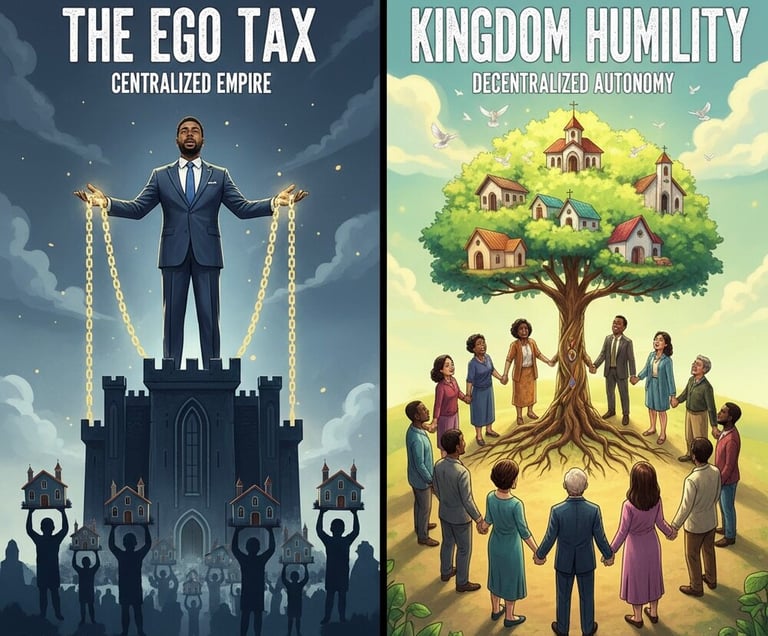
2. The Empire of Centralized Control
The most insidious form fuses the leader’s identity with organizational scale. Many Pentecostal/Charismatic networks still operate a fully centralized model: the founder/General Overseer retains ultimate authority over branches, finances, appointments, and doctrine—no matter the geographic distance.
Having served 17 years in such a system, I know the feeling intimately: capable ministers reduced to extensions of one man’s vision, where disagreement is labeled disloyalty and initiative is stifled by top-down directives. Many centralized models began with genuine vision and have borne real fruit—yet the Ego Tax can slowly distort even the best intentions, prioritizing the founder’s sense of control over local flourishing.
In contrast, decentralized “franchise” models grant genuine autonomy to local leaders while still supporting the wider network—releasing creativity, contextual relevance, and true Kingdom multiplication.
Conclusion
The lesson is the same for historical missionaries, short-term volunteers, and today’s apostles, prophets, and pastors: we must relentlessly examine our motives.
A decolonized mission demands a de-egoized leader—one who measures success not by control, profile, or scale, but by how many local voices are amplified and how many leaders are truly released.
Guiding Light Press, 4th Floor, Silverstream House, 45 Fitzroy Street, Fitzrovia, London, W1T 6EB. Website: Guidinglightpress.co.uk
Join the Discussion:
How can contemporary ministry leaders (apostles, prophets, pastors, founders) restructure their networks to move from centralized “Empire” models to decentralized, empowering “Kingdom” models?
#DecolonizingMission #EgoTax #MissionaryMotives #ChristianLeadership #DeJoeQuarcoo #GuidingLightPress
REACh out
hello@guidinglightpress.co.uk
© 2026. All rights reserved.
Address: 4th Floor, Silverstream House, 45 Fitzroy Street, London, W1T 6EB
Amplifying voices and reclaiming narratives through literature of liberation
Privacy Policy


Join the movement