
Subversion in Silence—Jesus’s Anti-Imperial Strategy
This strategy is further seen in Jesus's choice of location. He ignored imperial centers (Rome, Antioch) and focused his ministry at the margins—Galilee and Capernaum, the colonized periphery.
CRITICAL REFLECTIONS & DECOLONIAL INQUIRYDECOLONIZING MISSIONS
Joe Quarcoo
4/28/20262 min read
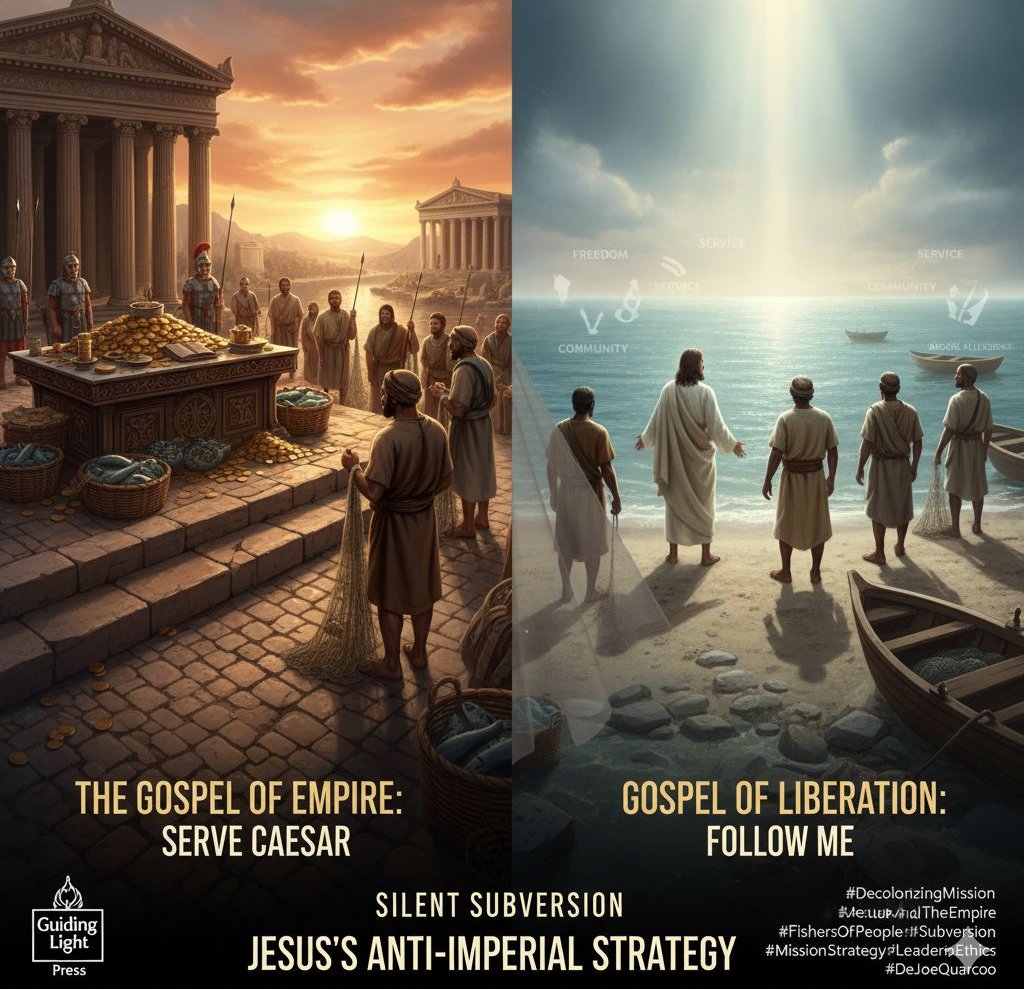
In our journey to Decolonize Mission, we now examine how Jesus, working under the heavy hand of the Roman Empire, launched a movement that would eventually conquer Rome—not with legions, but with radical subversion.
Harvey Kwiyani, Ph.D. shows us that Jesus's ministry was a masterclass in challenging empire, not by marching on Rome (which would have been suicidal), but by striking at its economic and ideological foundations.
Consider the simple command: "Follow me, and I will make you fishers of people." (Mark 1:17)
This was not just about saving souls. Fishing in Galilee was a highly taxed, state-controlled industry that funneled wealth to Rome. By calling fishermen like Peter, Andrew, James, and John to leave their boats, Jesus was:
Disrupting the Imperial Tax Base: Their labour and money would no longer be taxed by the empire, shifting resources away from Caesar's treasury.
Demanding Alternative Allegiance: They were being asked to serve a different Kingdom, committing their resources and labor to God’s work, subverting the empire "in a subtle yet big way."
This strategy is further seen in Jesus's choice of location. He ignored imperial centers (Rome, Antioch) and focused his ministry at the margins—Galilee and Capernaum, the colonized periphery.
A ministry that is truly decolonized requires us to follow Jesus's strategy: prioritizing the margins and disrupting systems (economic and organizational) that funnel resources to the center.
The Distinction: Kingdom vs. Centralized Church
It is crucial to clarify that the Kingdom of God is not the centralized, unaccountable, founder-led church (i.e., the organization). When many Bishops and leaders define the "Kingdom of God" as the Church (the corporation), they manipulate members to:
"Invest in the Kingdom" (i.e., provide money for church projects).
"Serve the Kingdom" (i.e., demand free, professional labor and extreme time commitments).
This is not service to the Kingdom; it is economic exploitation wrapped in theological language, replicating the colonial demand for forced, unpaid labor in exchange for "civilization." The Kingdom Jesus proclaimed is the radical demonstration of righteousness, peace and joy in the Holy Spirit expressed through justice and liberation in the world—a kingdom that disperses power and resources, rather than hoarding them in a central "empire."
Guiding Light Press, 4th Floor, Silverstream House, 45 Fitzroy Street, Fitzrovia, London, W1T 6EB.
Join the Discussion:
Does your ministry or organization's strategy reflect the imperial logic (following the money to the center) or the Jesus logic (prioritizing empowerment at the margins)? What organizational resources are you willing to shift to reflect "alternative allegiance?"
#DecolonizingMission #JesusAndTheEmpire #FishersOfPeople #Subversion #MissionStrategy #LeadershipEthics #HarveyKwiyani #DeJoeQuarcoo
REACh out
hello@guidinglightpress.co.uk
© 2026. All rights reserved.
Address: 4th Floor, Silverstream House, 45 Fitzroy Street, London, W1T 6EB
Amplifying voices and reclaiming narratives through literature of liberation
Privacy Policy


Join the movement