
Part 1: Contesting Fenced Futures – Capital Violence and the African Diaspora in a Shrinking World
"We invite melanin-rich bodies to prop up crumbling care systems, yet deny them soil to root in." In his latest review for Guiding Light Press, Joe Quarcoo (@Voice1Africa) tackles the "Treadmill of Precarity" facing the African diaspora. From the 2026 Home Office reforms to the "economy of erasure" in social care, this is a must-read for anyone fighting for migrant rights and decolonial thought.
CRITICAL REFLECTIONS & DECOLONIAL INQUIRYCAPITAL VIOLENCE
Joe Quarcoo
2/26/20265 min read
Reflections on Wavinya Makai’s Capital Violence – A Guiding Light Press Review Series
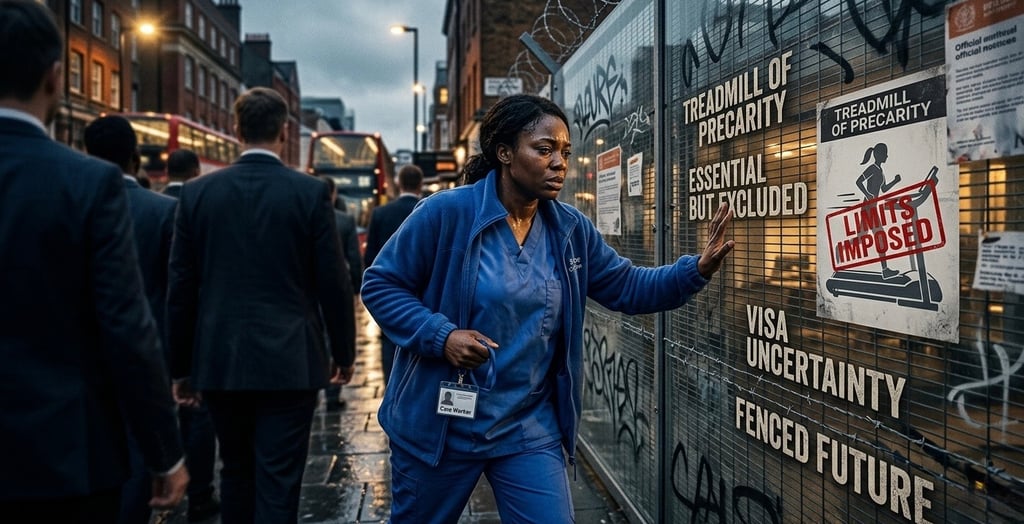
Wavinya Makai’s words on page 200 of Capital Violence hit like an ancestral gut punch: “Africa has always been prepared for tomorrow, but tomorrow has always been fenced off” (Makai, 2025). It’s not just poetry; it’s the raw truth of our existence, a perpetual tease where promise meets barbed wire.
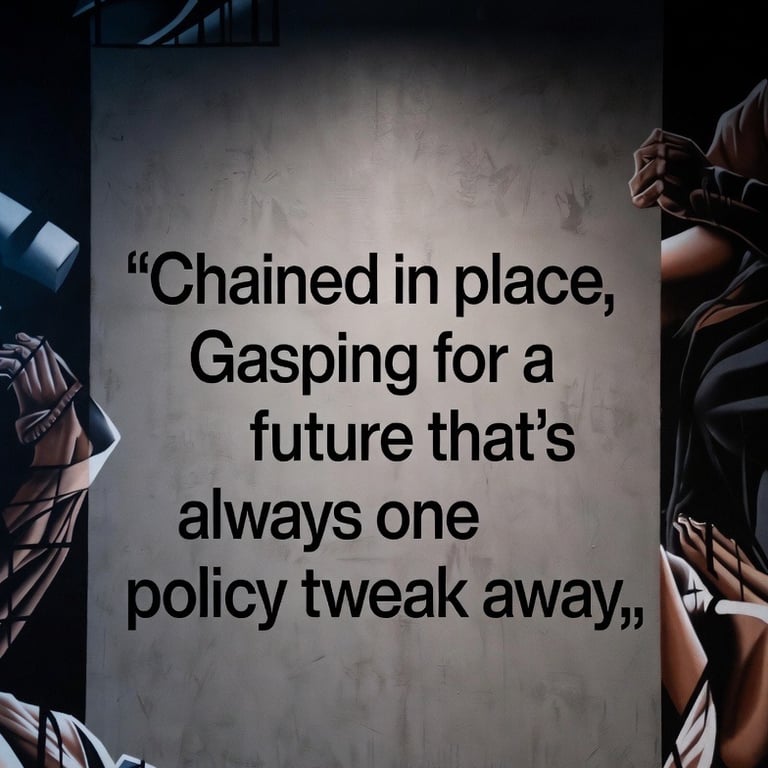
As an Applied Social Psychologist and frontline carer in the UK’s social care sector—managing the chaos of epilepsy seizures, autism meltdowns, and dementia’s fog amid my own visa uncertainties—I’ve felt this fence firsthand. It’s not some abstract barrier of wire or biometric scans; it’s a psychological stranglehold, what I term the “Treadmill of Precarity.” Picture this: You’re sprinting full throttle—juggling 60-hour shifts, wiring remittances home, dodging every infraction to stay “law-abiding”—only to realize you’re chained in place, gasping for a future that’s always one policy tweak away. This treadmill isn’t a glitch; it’s engineered to grind down Black and Brown spirits, turning resilience into exhaustion.
The Geography of Exclusion: From African Soil to Diaspora Limbo
Drawing from my years as an urban development practitioner specializing in informality, I’ve mapped these fences onto the geography of our lives—spaces rigged to exclude. On African soil, Makai nails it as “Fiscal Apartheid” (Makai, 2025): Multinationals swoop in with “million-dollar tax holidays” to bleed minerals dry, while the welder in Kitwe or the market mama in Accra begs for a micro-loan, denied for lacking “collateral.” This isn’t oversight; it’s the system firing on all cylinders to “amputate ambition,” ensuring local ingenuity stays unfunded and unauthorized (Makai, 2025). Wealth flows out, pockets stay empty—classic capital violence.
But make no mistake, this brutality doesn’t stop at borders. In our shrinking global village, it’s exported to the diaspora, morphing into the proposed UK Home Office’s ILR reforms. The consultation—closed on February 12, 2026, after 130,000 responses—seeks to double the baseline from five to ten years, with extensions up to 20-30 for benefit users or those in “low-wage” sectors like social care. Implementation hits as early as April 2026, retrospectively snaring folks already here. This is spatial injustice at another level, as critical human geographer Shahid Vawda would call it—channeling African labour into “precarious niches” while fencing off permanence (Vawda, 2023).
"This brutality doesn’t stop at borders. It’s exported to the diaspora, morphing into the proposed UK Home Office’s ILR reforms; channeling African labour into “precarious niches” while fencing off permanence"
We invite melanin-rich bodies to prop up crumbling care systems, yet deny them soil to root in. Psychologically? It’s chronic stress induction, breeding what Frantz Fanon termed the “epidermalization of inferiority” (Fanon, 1952)—a fractured self where you’re forever an “object of threat,” not the author of your story (Makai, 2025). How does a decade-long limbo shatter families? Imagine sending kids back home because dependents are banned, or burning out from shifts that barely cover rent—all while your “conditional” status hangs like a guillotine. This “long wait” isn’t neutral; it’s a betrayal, begging heroes during and post COVID then fencing them out with discursive narratives.
The Home Office claims fiscal prudence, curbing a projected 1.6 million ILRs by 2030 to ease benefit strains. But Makai exposes it as racialized control—post-Brexit, Nigeria alone supplies 20% of health & care visas/staff, targeting Africa to fill critical gaps, only to scapegoat us amid “net migration” hysteria. Geopolitically, it’s core-periphery warfare, extracting skills without equity.
The Gendered Layer: Double Erasure in the Care Chains
Let’s analyse this further: Women bear the brunt, forming the backbone of global care economies. Sylvia Tamale’s Afro-Feminism rips open how capitalism turns African women into “cheap migration labor,” weaving race and gender into draining chains (Tamale, 2020). In UK social care, these sisters—managing challenging behaviours or autism’s storms—echo Ama Ata Aidoo’s diaspora warriors in Our Sister Killjoy (1977): Hailed as saviors post-COVID, now fenced by visa renewals and dependent bans (Home Office, 2025).
This is Necropolitics in action (Mbembe,2019). Sovereignty here is the power to let a population live in a state in permanent “limbo” - extracting their labour while dangling the “mirage of settlement” just out of reach. It is an “economy of erasure” that commodifies the heart-using rhetoric like “you’re supporting the most vulnerable in our society”-While discarding the person behind the care.
"Hailed as saviors post-COVID, now fenced by visa renewals and dependent bans with discursive narratives."
As someone easing learning disabilities, autism, and mental illness episodes while visa fears claw at my gut, I know this economy of erasure commodifies our hearts. Delayed ILR means burnout carers, compromising patient care—fencing hurts everyone, from the autistic child needing stability to the dementia elder craving familiarity. Some say it’s anti-exploitation, but when 70% of care migrants are women from the Global South (Insert reference), it’s gendered predation, not protection.
Unfencing the Bridge:
Adebayo Adedeji dreamed the diaspora as Africa’s sovereignty bridge, not exiles (Lagos Plan of Action, 1980). Yet UK policies twist it into a fenced pier—see the shore, never land. A “branded out” diaspora means sabotaged futures: Productive years lost to precarity, remittances diverted from liberation to survival.
But nuance demands hope amid critique. Emerging protests signal resistance—over 50 MPs demanding a revocation of these proposals; 130,000 consultation voices hopefully roaring against retrospective application of the proposal. In Part 2, we’ll unpack the COVID betrayal deeper.
The Call to Action: Demanding Epistemic Justice Now
We rise, not by their grace, but our grit—demolish these fences. Demand epistemic justice: Reclaim narratives where we’re authors, not threats.
I invite all concerned citizens, policymakers, allies, and the broader British public to join the fray:
Fair Visa Campaign: Support petitions like the February 2, 2026, e-petition for care professionalization—reject “unskilled” labels when we sustain lives, recognizing the value for UK society as a whole.
Challenge Retrospectives: This 10-year retroactive change breaches the psychological contract from COVID recruitment—rally via groups like Migrants’ Rights Network to ensure fairness for those who keep Britain’s vulnerable safe.
National Care Service: Advocate Fair Pay Agreements recognizing care as an economic pillar, not an exploitation pool—UNISON’s 2026 women’s conference amplifies this, benefiting workers, patients, and the UK economy.
We’re self-determined contributors who answered the UK’s desperate call—demand dignity for all, or watch the system crumble under its own inequities. The bent back straightens by our collective hands.
Publish your book with Guiding Light Press—we build monuments of decolonial thought.
Contact: guidinglightpress.co.uk, hello@guidinglightpress.co.uk, 4th Floor, Silverstream House, 45 Fitzroy Street, Fitzrovia, London, W1T 6EB.
#TheHustle #Voice1Africa #GuidingLightPress #CapitalViolence #FencedFutures #SpatialInjustice #DeJoeQuarcoo
REACh out
hello@guidinglightpress.co.uk
© 2026. All rights reserved.
Address: 4th Floor, Silverstream House, 45 Fitzroy Street, London, W1T 6EB
Amplifying voices and reclaiming narratives through literature of liberation
Privacy Policy


Join the movement